

THE JOURNAL · LUXURY INTERIOR STYLING IDEAS
Luxury Needlepoint Pillows in Europe: Why Handmade Still Matters
In an era of infinite choice and identical interiors, the handmade object has become the rarest thing of all.
Here is why that matters — and why it always will.
BY ELEONORA FREY OUR HOME OUR CASTLE, USTER SWITZERLAND
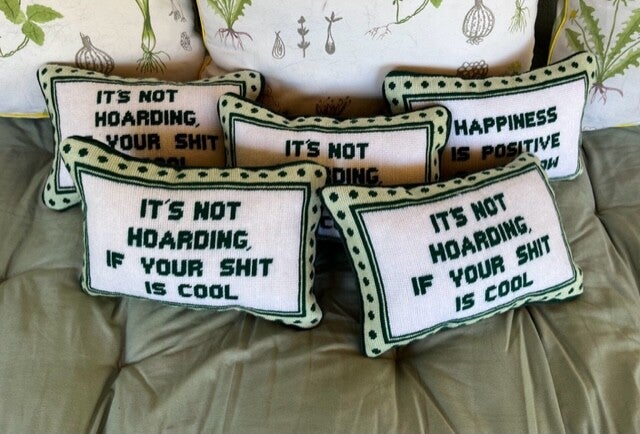
There is a particular kind of luxury that cannot be manufactured at scale. It has nothing to do with price tags or brand names. It is the luxury of the object that took time — real time, human time — to exist. A needlepoint pillow made by hand in Europe is exactly that kind of object. And in a world that has optimised almost everything else for speed and volume, it has become something genuinely rare.

As seen on pinterest https://ch.pinterest.com/eleonorafrey, thousands of individual stitches. Every one of them placed by hand.
What luxury actually means — and what it doesn't
Luxury has been diluted. The word now attaches itself to hotel shower gels, supermarket biscuits, and cars with heated cup holders. When everything is luxury, nothing is. The word has lost its weight because it was never meant to describe a price point — it was meant to describe an experience of rarity, craft, and time.
True luxury is not about what something costs. It is about what it required to exist. The hours of skilled attention. The materials chosen for quality rather than margin. The maker who understood exactly what they were doing and why. By that measure, a hand-stitched needlepoint pillow made in Europe is one of the most genuinely luxurious objects you can bring into a home — and one of the most underestimated.
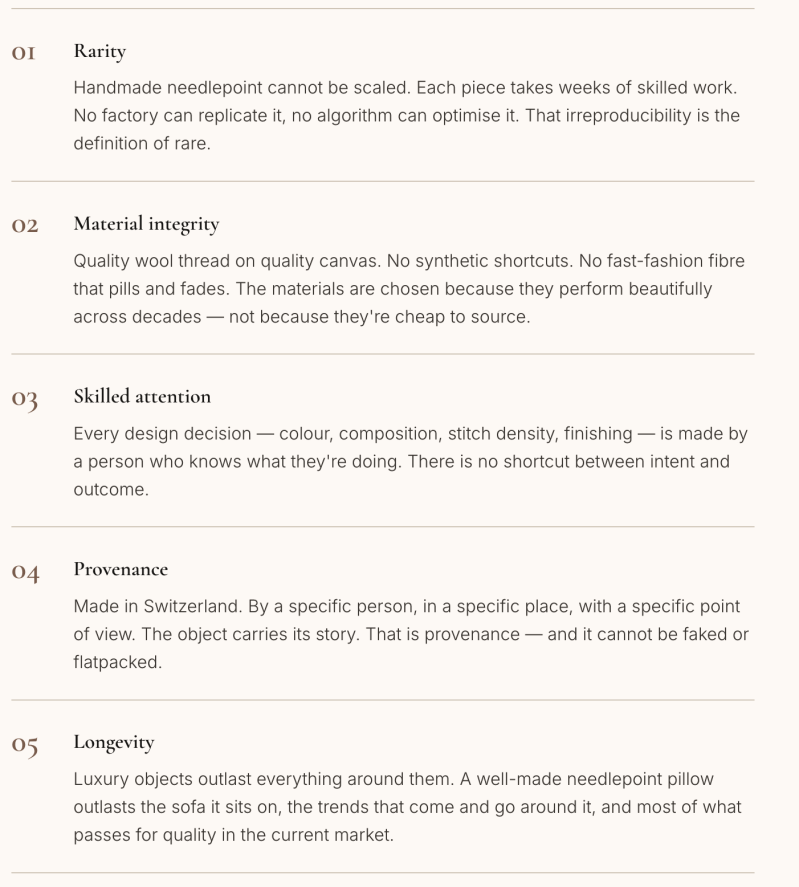

Handmade vs. mass-produced — what you are actually choosing between
The market for decorative pillows is enormous and largely indistinguishable. Scroll any home goods website and you will find hundreds of cushions at similar price points, with similar patterns, made by processes that are entirely invisible to the buyer. Most are printed on fabric in bulk. Many are produced in conditions that don't bear examining. Almost none will look good in five years.
This is not a moral argument. It is a practical one. When you choose a handmade needlepoint pillow, here is what that choice actually means:
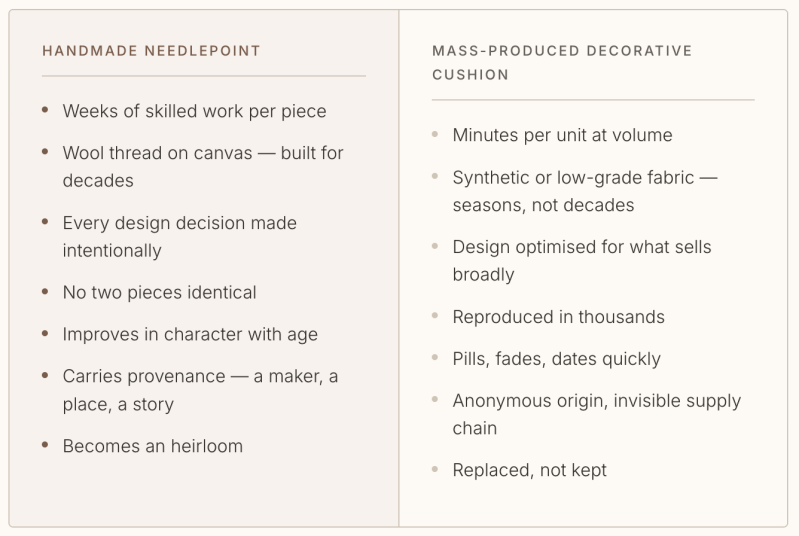
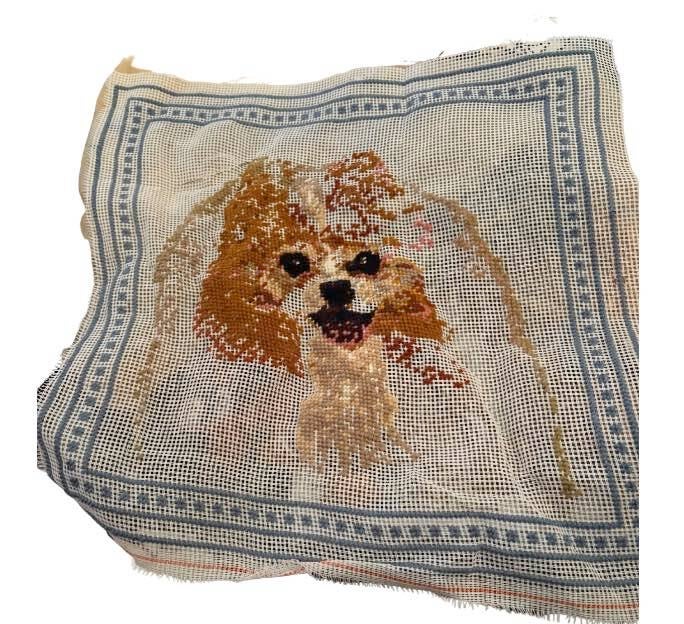

The work that cannot be scaled.
The surface that rewards looking closely.
Why Europe — and why Switzerland in particular
Europe has a long and serious relationship with handmade textiles. From the tapestry workshops of Flanders to the embroidered silks of Lyon, from Florentine needlework to the needlepoint traditions of English country houses — the craft of working by hand on canvas or fabric is woven into the continent's making culture in a way that runs far deeper than trend.
Switzerland occupies a particular position in that tradition. The country has one of the oldest textile industries in the world — St. Gallen embroidery has been internationally renowned since the 19th century. Swiss craftsmanship carries with it a reputation for precision, quality, and a refusal to cut corners that is not marketing — it is genuinely cultural. Things made in Switzerland are made to last. That is simply how things are done.
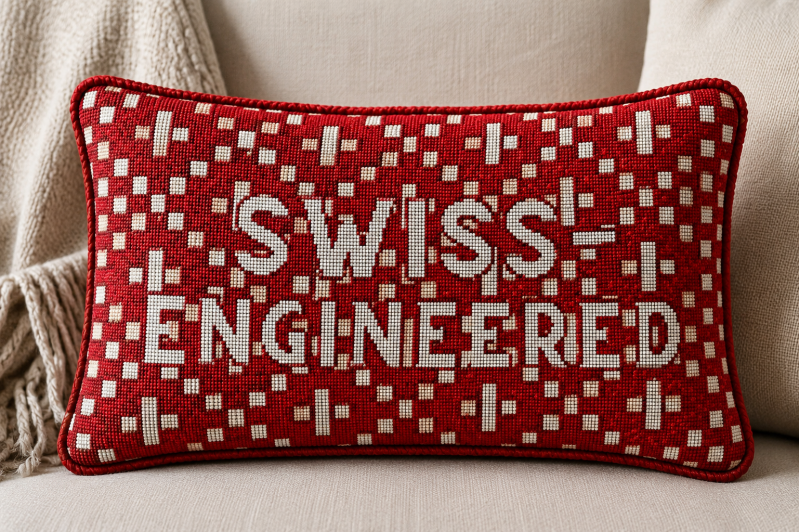
Europe has a long and serious relationship with handmade textiles. From the tapestry workshops of Flanders to the embroidered silks of Lyon, from Florentine needlework to the needlepoint traditions of English country houses — the craft of working by hand on canvas or fabric is woven into the continent's making culture in a way that runs far deeper than trend.
Switzerland occupies a particular position in that tradition. The country has one of the oldest textile industries in the world — St. Gallen embroidery has been internationally renowned since the 19th century. Swiss craftsmanship carries with it a reputation for precision, quality, and a refusal to cut corners that is not marketing — it is genuinely cultural. Things made in Switzerland are made to last. That is simply how things are done.

Designed and handstitched in Uster, Switzerland. The place is part of the object.
The slow living argument — why handmade has never been more relevant
There is a growing exhaustion with the pace of modern consumption. With the cycle of buying, discarding, and buying again. With interiors that look identical because they were assembled from the same four sources. With objects that feel like placeholders rather than decisions.
The response to that exhaustion — the thing that more and more people are reaching for — is the handmade object. Not as a nostalgic gesture, but as a deliberate one. A needlepoint pillow is slow by nature. It cannot be rushed. It requires the kind of sustained, focused attention that the rest of modern life has systematically trained us away from. And the result of that attention — that refusal to cut corners or speed up — is visible in the finished piece. You can see it. You can feel it.
Buying handmade is not a rejection of modernity. It is a very modern decision to spend money on things that mean something, last properly, and bring a different quality of presence into a home. The slow object, in a fast world, is a radical act.

Beyond the materials, look for a maker with a distinct point of view. Luxury needlepoint is not just technically excellent — it has something to say. A design sensibility that is coherent, considered, and genuinely original. Anyone can stitch a canvas. The difference between a craft object and a luxury object is the vision behind it.
Look also for provenance you can actually verify. Where is it made? By whom? Can you ask questions and receive real answers? The best makers are proud to tell you exactly where and how their work is produced — because transparency is itself a mark of quality.

Handstitched in Uster, Switzerland. Ready for wherever in the world you call home.






Add comment
Comments